Each to their own. However, I do find the discussion amongst international residents on social media groups around the topic of fireworks in Valencia to be tiring. And very often far too aggressive.
My first encounter in the city was many years ago. I had never heard of the festival and, as a Brit, my deepest experience of explosive materials is twofold. On Bonfire Night every November 5th, the UK celebrates a chap known as a conspirator.
Public firework displays are held across the country along with flaming pyres and burning effigies. Hence the colloquial name. Millions of people also gather to ignite their own personal collections. Named Guy Fawkes, he attempted to blow up the Houses of Parliament, Great Britain’s seat of Government, in 1605. In today’s world he would most certainly be referred to a terrorist.
One childhood memory is of being stupid enough to hold a rocket, which, as the name implies, is designed to shoot into the sky and not be restricted in it’s freedom. The burn to my ten year old hand was fortunately not too painful. Explaining my deeds to my parents was, if only emotionally.
Secondly, my life in Germany taught me to anticipate their huge passion for gathering every new year’s eve for colourful displays large and small on. A widespread and highly disgraceful mess on the ground was visible over the next few days but seemed to be accepted by all.
Fallas Tradition
Valencia’s Fallas event has been held annually since the eighteenth century and firmly established in the late nineteenth. It arose through carpenters burning piles of unused wood scraps and other materials in front of their workshops on the eve of Saint Joseph’s Day, the patron saint of carpenters. This marked the arrival of spring with longer days and less need for artificial light. March 19 remains the date of the big burn.
When fireworks became part of the celebrations remains murky. However, the local’s passion for noise most likely reaches back to the time of the Moors. Although founded as a Roman colony in 136 BC, the country was, apart from one brief period, under Muslim rule between 714 AD and 1238 AD.
A dear friend who is extremely passionate recognises and honours the choreography of each individual display of the daily firecrackers, or mascletas. Like it or not, it is, in fact, an art from.
I encountered my first mascletas one Sunday morning, some ten years ago. It was early on a sunny Sunday morning shortly before a flight as I drank a coffee on the balcony. I observed large numbers of people carrying picnic baskets and flowing towards the city square..
Curiosity got the better of me, so I walked there too, coffee in hand and asked a policewoman what was going on. She merely said I just just wait a few short minutes. My word, the noise was excruciating.
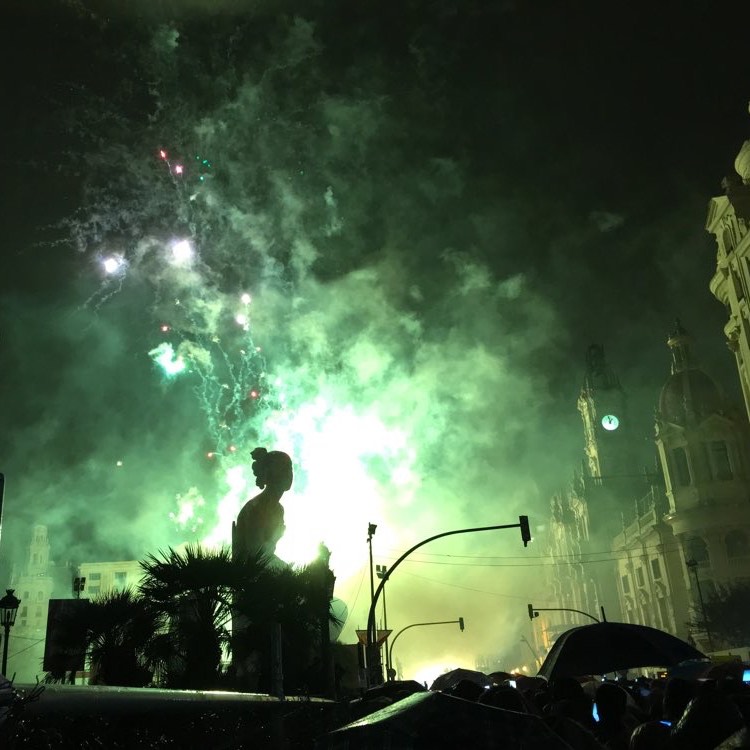
Unbeknown to me, they were celebrating the Fallas awakening and the Plaza del Ayunamiento was far from full. Everyone was very close to the action and we stood literally underneath the impressive display. Beyond excruciatingly loud bangs, the smoke became quite unbearable during those ten or so minutes. It was certainly eye-opening.
Relocation Choices
Meanwhile, several expat groups on social media are host to discussions on the topic. This I find to be a rather pointless endeavour, highly unproductive and a source of much aggression.
Most certainly, when one decides to relocate, a good amount of research is done. Diligently or not, when a move has been decided, the whole package has been chosen, knowingly or not. Whether history, tradition, culture, vibe, liveability, cost of living, employment opportunities, accommodation, healthcare, noise, traffic, public transport, walkability, safety, weather, greenery, open spaces, services, shops, you name it, they are all unique to the city.
Valencia offers it’s package to all who arrive. From friendly and welcoming residents to Fallas celebrations. The latter is finite. A few weeks of fireworks that one may enjoy or disagree with, are part and parcel of this wonderful city.
For a large percentage of the native population the festival is most certainly something they would wish to avoid. Many disagree with the pollution, regardless of whether it affects the lungs or the ears. Some retreat to their second homes or head off for vacation.
Interestingly, one effect of the celebrations is a sharp decline in vehicles on neighbourhood streets for many days. I have not noticed this aspect being placed into context concerning the quality of the air during this time. Although a quick search reveals troubling results.
While capped streets do result in a reduction of Nitrogen Oxide, this is little compensation because, according to ScienceDirect, other pollutants are released by the displays. Phenomenally high spikes in potassium, aluminium, titanium, magnesium, lead, barium, strontium, copper and antimony have been recorded.
Whilst transient in nature due to short bursts of ten minutes during the early afternoon firecrackers and longer evening or nighttime pyrotechnics displays, the effect can be troublesome for many suffering from a variety of ailments.
Furthermore, the final day sees hundreds of statues large and small being burned within just a short few hours during the evening of March 19. Since they are made not only of wood but polystyrene and are covered liberally with paint, the quality of air in the city hits rock bottom. And, depending upon the weather, can stay that way for several days and even longer.
Local Debate
This is known by the city administration and UNESCO, who declared the event an “Intangible Cultural Heritage of Humanity” almost ten years ago. However, since they state “The festivity is held annually from March 14 to 19”, the declaration would not seem to cover extracurricular activities.
Also, according to the Universitat de Valencia, “The candidacy of the Fallas to be declared a World Heritage had to face some negative allegations made by neighbours. It was mainly criticised because of the dirtiness, the pollution and the organisation of bullfights during the festivity.”
And further: “The complaints were formally answered in front of the intergovernmental commission, and it was affirmed that the reintroduction of cloth and cardboard (the traditional materials for the construction of the monuments) is already being encouraged by the institutions. In addition, they said that, according to some experts, the daily fumes of cars and burned oils cause more pollution, an aspect that is minimised during the festivity, since the traffic is significantly reduced.” How interesting.
As a publisher of online resources for international residents, I have posted about Fallas activities for many years. I can confirm that the frequency of pyrotechnic displays has increased noticeably and is higher than ever in 2026.
Chill Or Act
It would seem rather rudimentary to comment on social media groups catering to foreigners, their likes or dislikes and their opinions. It would be perhaps more conducive for someone passionate about making a difference to enter local politics and fight for change.
Good luck with that. The Fallas “casals” or commissions number four hundred or so. Their members alone make up almost a quarter of the population of Valencia capital. They are a powerful group of people whose individual members reach deep into the heart and soul of society.
Be prepared for a lengthy uphill climb, to say the least. Meanwhile, here’s wishing much joy to those busy complaining and even more equanimity to those who declare they should “go back home”. Even though this marvellous place is, indeed, exactly that (their home) for most commenters.
Rest assured, when this all blows over, the next session begins again in eleven months time accompanied by the perpetual, annual debate.
By Vincent Green, Mar 17, 2026